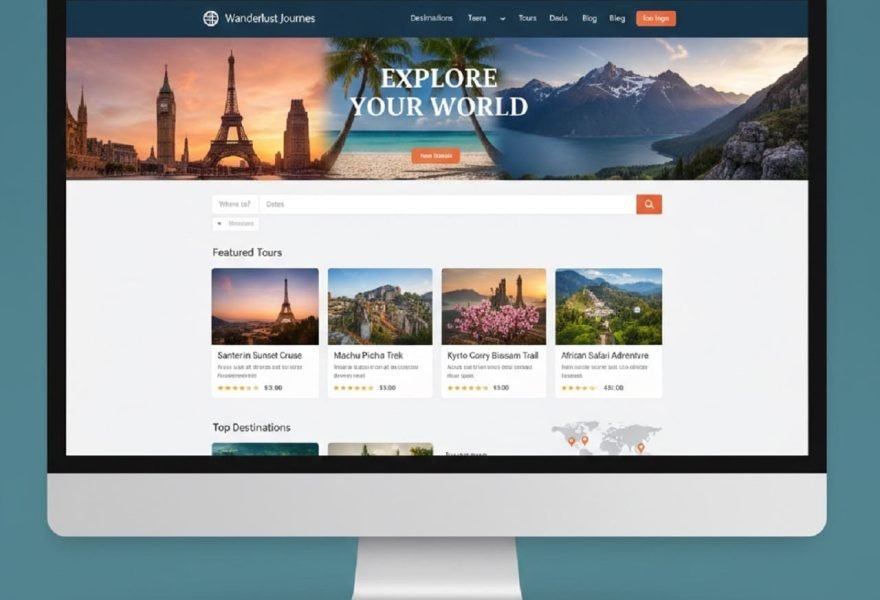
Improve travel website conversions with user-focused design, clear booking journeys, and data-driven optimization that turns visitors into inquiries, bookings, and long-term customers.
Overview
One of the travel and hospitality businesses was generating consistent website traffic with organic search, social media and paid campaigns, but the bookings and enquiries were very low. Tourists were visiting several pages and exited before making reservations or even filling inquiry forms. The site was not able to turn interest into revenue despite the investment made in the marketing process.
The overall problem was not the traffic, but the user experience, clarity, and trust. The site was not designed with a conversion approach, no calls-to-action, not mobile-friendly, and convincing message with regards to traveler expectations.
It was not easy to make a decision, and the steps to price, packages, and booking were not clear. TryGaze Digital Solutions collaborated with the client to identify the problem areas of the conversion, and re-design the digital path.
The UX enhancements, performance gains, content restructuring and data-driven conversion tactics allowed us to turn the site into a high-performing sale channel that made users take action with the necessary confidence.
User Experience Optimization
Better navigation, layout clarity, mobile responsiveness, and Page speed to minimise friction and provide a convenient browsing and booking experience to travellers.
Conversion-Centered Design
Implemented transparent call-to-actions, trust signals, testimonials, and booking notifications that are strategically positioned so as to direct visitors to inquiries and bookings.
Content & Messaging Clarity
Repackaged content to emphasise benefits, packages, pricing transparency and unique travel experiences to match traveler intent.
Data-Driven Decision Making
Applied analytics and heat maps in order to locate points of drop-off and constantly improve pages to achieve increased engagement and conversion.
Much of the traffic was mobile and the site was not mobile-optimized to make a mobile conversion and thus it missed the opportunity.
These problems added to the restriction of revenue in spite of good traffic volumes.
How It Works!!
We Follow Below Resolution Process :
01
Strategy & Research - Conversion Audit & UX Analysis
The behavior of users, traffic origins, heat maps, and funnel served as the inputs that we analyzed to identify the precise bottlenecks in the conversion process and prioritize effective improvements.
Adopted clean/mobile first, faster page speed, easier navigation, and lean layouts to make easier decisions and easier bookings.
03
Conversion Growth - Content & CTA Optimization
Optimized hierarchy of content, inclusion of persuasive text, elements of trust and salient CTAs to show the consumer the right direction either through booking or inquiry.
04
Analytics - Tracking & Continuous Optimization
Install conversion tracking, goal monitoring, and A/B testing so that the performance can be optimized on a continuous basis and ROI on the available traffic can be maximized.
Results & Conclusion
Following the conversion-oriented improvements, the travel site underwent a quantifiable change in the level of user interactions and booking efficiency. The rate of bounces reduced to a considerable extent as the visitors started spending more time reading packages, itinerary and accommodation options. The reworked booking experience helped the user to make queries and bookings unambiguously.
The conversion rates of the mobile improved significantly and this is in line with the increased trend where travelers are doing their research and making bookings through their smartphones. International visitors who were not familiar with the brand felt more confident as there were clear-cut calls-to-action and trust elements.
Having adequate analytics enabled the business to have a glimpse of how the users behaved, making decision making on marketing and the web site smarter. The current traffic sources started to bring more returns and required less ad expenditures, which enhanced the overall efficiency of marketing.
This case study demonstrates that maximizing user experience and conversion flow, and not just more traffic, can open the door to high revenue growth. In the case of travel and hospitality businesses, conversion optimized site has become not a luxury, but a key ingredient of the sustainable digital performance.