
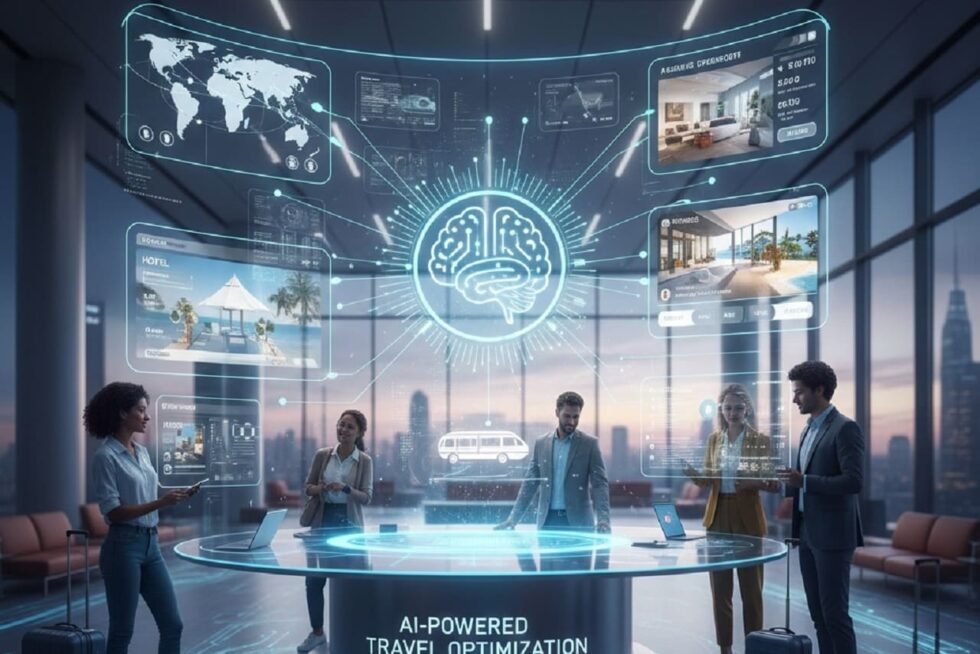
The travel and hospitality sector is changing faster than ever before through Artificial Intelligence (AI). AI is transforming the nature of interaction between travel businesses and their customers, operation management and revenue growth through smarter booking engines, customized guest experiences, and more. AI has emerged as a force of enabler of growth and customer satisfaction in a very competitive industry that is experience-oriented.
Artificial intelligence Travel Booking Experiences
The classic travel booking systems are characteristically one-size-fits-all. This is altered by AI who analyzes user behavior, interests, search history, location, and booking patterns to provide a personalized recommendation.
Booking engines powered by AI can make recommendations (destinations, hotel, tour package, or additional), according to the interests of each traveler. Not only does this make it easier to make decisions to the customers but also enhances the conversion rates and average booking values to the travel business.
AI-based dynamic pricing adapts prices dynamically according to demand, seasonality, competition, and user behavior- aiding businesses to maintain competitiveness as well as maximize revenue.
Virtual Assistants and Intelligent Chatbots
Chatbots that are powered by AI are transforming the customer service in the travel industry. These virtual assistants are available 24/7 and can cope with more general queries like availability, pricing, booking status, cancellations and travel details.
The AI chatbots do not rely on the classic help mechanism, as they learn and evolve more and more. They decrease the response time, cut support expenditures, and offer uniform service across the websites, mobile apps, WhatsApp, and social media sites.
To the travellers, this translates to immediate help. To companies, it translates to increased efficiency and satisfaction to the customer.
Individualized Customer Experiences
AI can be used to provide very personalized experiences throughout the customer journey-inspiration to post-trip experience.
Through analysis of customer information, AI can be used to customize email, website, offers and remarketing advertisements. As an illustration, a user who is interested in wildlife safaris might get personalized information, tour packages, and special deals about nature tourism.
Such degree of personalization will establish greater emotional appeal to travelers, generate repeat bookings, and boost brand loyalty.
Improving the Customer Experience in Travel
AI doesn’t stop at bookings. It is also critical towards enhancing the on-trip and post-trip experience.
Hotels apply AI to automate the room preferences, check-in services, voice assistants as well as service requests. The travel applications use AI to provide real-time updates, itinerary revisions, and weather notifications and recommendations.
Sentiment analysis tools keep track of reviews and feedback to detect gaps in the service and enhance satisfaction among guests. This initiative will assist travel brands to respond to problems before they can affect reputation.
Smart Marketing and Lead Optimization
Artificial intelligence marketing technologies process plenty of data to recognize high-intent travelers and streamline campaigns. AI enhances marketing ROI by eliminating possible improvements in the marketing process, such as ad targeting and budget allocation, to creative optimization.
Machine learning algorithms identify the leads that are more likely to convert, and sales teams target high-value leads. There is also AI to help with automating follow-ups, abandonment booking recovery and remarketing campaigns.
This leads to an improvement in the quality of the lead, a decrease in the acquisition cost and an increase in the number of the booking conversions.
Efficiency and Cost minimization of operations
The AI reduces the working of the back-end including inventory control, demand prediction, fraud detection, and resource planning. Travel businesses have the opportunity to minimize the amount of manual work, decrease the error rate, and enhance the accuracy of decisions made.
AI-driven automation enables teams to concentrate on strategy and relationships with customers instead of on routine work.
Conclusion
The concept of AI is no longer a vision of the future, but a current need of travel and hospitality companies. AI improves every step in the traveler experience, whether it is the individualized booking experience, smart customer service, or smarter marketing and operation.
Brands that adopt AI are competitive, enhance customer experience, and realize scalable and sustainable growth in the ever-digitizing world.

